

SENSRI: A New Science Integrating Humanity and the Environment
Download a preview of Michael D'Aleo's new book
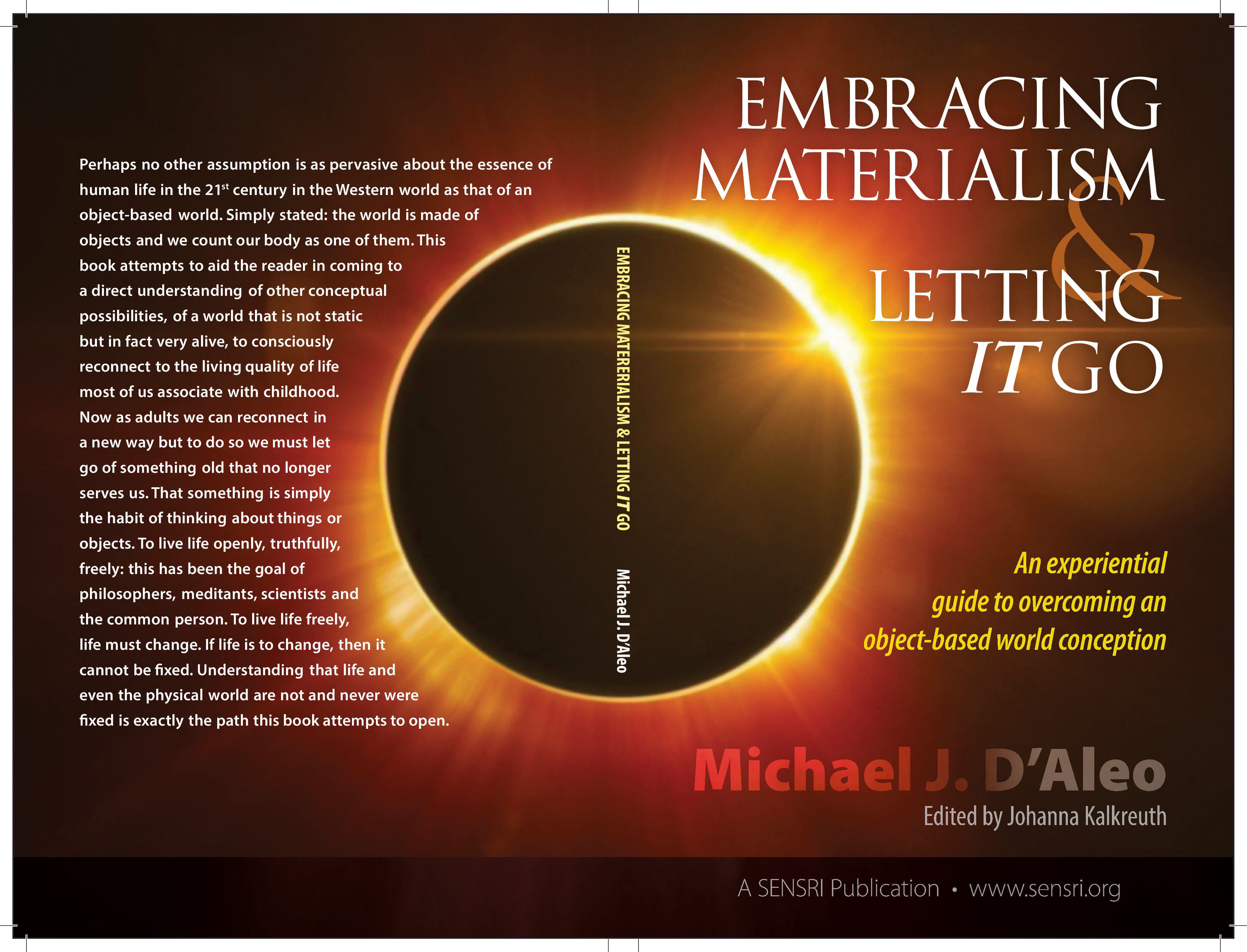
Michael's most recent work entitled Embracing Materialism and Letting It Go
A New Science Integrating Humanity and the Environment
Our mission is to promote research, education and the exchange of ideas growing out of a new science based on active human perception. By developing new capacities of sensing and thinking we envision and design creative environmental technologies, in harmony with nature, meeting human needs.
Since 1999 SENSRI has worked as a non-profit research institute in Saratoga Springs, New York, to develop practical solutions to questions of science, technology and the environment by working from a new understanding of human perception and experience. You can read more about our history here, or meet our researchers and board members by clicking here.
On our Research web page you can learn about our current research activities, such as the Living Waters project, or the behavior of artesian springs in Saratoga Springs, or how current explanations of global warming focus so much on a single atmospheric constituent - carbon dioxide - that we ignore important elements of the larger picture.
SENSRI also provides educational courses and science workshops, as well as resources for educators; you can learn more about these on our Education page.
Our work at SENSRI involves learning new ways of perceiving, freeing our selves from fixed or static concepts, and applying new approaches to experiencing our world. In this, we find we have much in common with artists who also seek to free themselves from conventional viewpoints, to see our world in new ways. Here, on our Art and Environment pages, we invite you to experience the perspectives of artists whose work demonstrates new ways of seeing the world.
SENSRI Publications and Newsletters, as well as descriptions of some of our Past Events, can also be found here. Please read on and explore our site to learn about how SENSRI and you can work together to develop new perspectives on our world that will integrate humanity and environment into a seamless, sustainable unity.
Featured Essays:
Real Hope, Real Change
A recent article by Michael D'AleoEight years ago, in October 2003, the United States Military commissioned a study to consider some of the extreme but "plausible" scenarios surrounding the issue of climate change. The report was titled An Abrupt Climate Change Scenario and its Implications for United States National Security and was written by Peter Schwartz and Doug Randall. The report made mainstream news when a summary of it was published in an article in Fortune Magazine entitled Climate Collapse by David Stipp (Fortune, January 26, 2004). The report considered the possibility of many extreme possible changes to the earth that might occur due to possible human induced changes to the climate. One of the key scenarios described how by 2011 the effects of significant global warming might cause a shutdown of the gulf stream in the Atlantic Ocean, causing the Scandinavian counties to experience unprecedented cooling. The report went further to postulate the possibility that this would result in a huge displacement in the population of the world as it sought warmer climates and lead to a war for space and resources. According to this report, it was a possibility that Scandinavia would be essentially uninhabitable by 2011. In 2004 a movie, The Day after Tomorrow, depicted the possibilities examined in the Pentagon's report. In many ways, the report served as the plot script for this movie, which created fear, anxiety and a sense that we'd better do something about this climate change issue. Interestingly enough, in one part of the movie the studio created an animated scene of a huge glacier breaking apart and falling into the ocean. This studio-created scene was later taken and used in another movie on climate change, Al Gore's 2006 "documentary," An Inconvenient Truth.Continue essay...
Water, Energy and Global Warming
Michael D'Aleo and Stephen EdelglassRevised and updated by Michael D'Aleo, July 2009
During this scientific era we have learned to speak of causes and effects. While this language can be useful, it can also mislead, as when the public is brought to focus upon El Nino as the "cause" of altered weather patterns around the world. Yet El Nino is a seamless part of the global weather picture, and is as much the result of ongoing changes as their cause. By itself it explains nothing. An undue focus on causes and effects encourages us to fragment the earth's natural cycles and lose sight of their integral unity.
We suspect that this affinity for well-defined causes (often portrayed as villainous or sensational) throws light on the current debates about global climate change. The focus upon a single atmospheric constituent -- carbon dioxide (now widely viewed as a dangerous pollutant) -- may have encouraged us to ignore elements of the larger picture. Our intention in this article is to illuminate another part of that picture (although in a way that may prove startling): it appears that perfectly "harmless" water vapor and the quantity of energy released with it may be at least as much the villains as carbon dioxide. Download article as PDF...
The New Environmental Aesthetic
Michael D'Aleo
It is hard to pick up a newspaper these days without coming across a headline story speaking about the precarious state of our environment. Issues such as global climate change, peak oil, genetic engineering, suburban sprawl, bird flu virus and a host of others catch our attention, and become eclipsed by ever new concerns. It is often the case that continued scrutiny of these problems reveals that many of them have very different dimensions than initially described, while the solutions proposed for the problem du jour often turn out to be less of a solution than what was needed, or even become new environmental problems. Continue essay...
Reliability, Predictability and Scientific Knowing
Michael D'Aleo
I am not interested in what you think will work or what should work theoretically; build me a working model! This statement was repeated many times in the engineering career I had in the electronics industry prior to my teaching career. The owner and CEO of the company I worked for had a Ph D in Physics from Perdue University and had also served in the Navy. He had built the company up from nothing and the key to his success was that every product the company sold would work the first time, it was easy to use and it would be reliable for a long time. He knew all the reasons why something should work, but he was only interesting in spending time with the designs that were brought to him for approval that were actually working models. He wanted to see it, feel it, to actually interact with the equipment. There was a time for theoretical ideas but in the end he ultimately respected what was sensibly in front of him.. Continue essay...